


Showing posts with label sony. Show all posts
Sony's SmartEyeglass to Launch Next Year


At very first it was Google who came up with Google Smart Glass then after a long gap Lenovo also announced of its upcoming Lenovo Smart Glass followed by China’s search giant Baidu who announced Baidu Eye a chinese smartglass to rival Google and now this time it was technology giant Sony who also announced its Smart Eyeglass in Tokyo, Japan on Friday, 19th September, 2014. The SmartEyeglass from Sony is a transparent lens eyewear that works by connecting with compatible Smartphones to superimpose information such as images, texts, and symbols, onto the user’s field of view. Only Smartphones having Android 4.1 or later will be compatible with the SmartEyeglass. Further, Android 4.3 or later is necessary in order to make use of the video functionality of the camera.
The SmartEyeglass will offer the users a diverse range of sensing technologies, which includes an accelerometer, brightness sensor, Gyroscope, a CMOS image sensor, microphone and an electronic compass. The SmartEyeglass makes use of the above mentioned features along with the GPS location information provided by the connected Smartphone, in order to give information most optimized to the user’s current circumstances.
Technical overview of the SmartEyeglass prototype
- Binocular see-trough eyewear display.
- Monochrome green colour.
- Maximum display brightness: 1000cd/m2.
- Embedded camera.
- Accelerometer, gyro, compass and brightness sensors.
- Microphone.
- Bluetooth v3.0.
- WiFi – 802.11b/g/n.
- Separate controller with touchpad along with power, navigation and camera buttons.
At the announcement, Sony also demonstrated some preloaded apps on the SmartEyeglass. A Localive app provides social feeds aggregation and distribution for surrounding local area whereas its-mo NAVI for SmartEyeglass app provides pedestrian navigation. Sony has also announced the availability of a dedicated SmartEyeglass Software Development Kit (Developer Preview) which would enable developers to think upon new and innovative ideas for creating scenarios where the device can be used. The kit will also boost the development of various applications. The kit comes with an emulator, sample code, tutorials to get started, In-depth developer guides, Design guidelines, API references, test instructions and Publishing guidelines.
Sony QX1 Lens Attachment Will Turn Your Smartphone into a DSLR

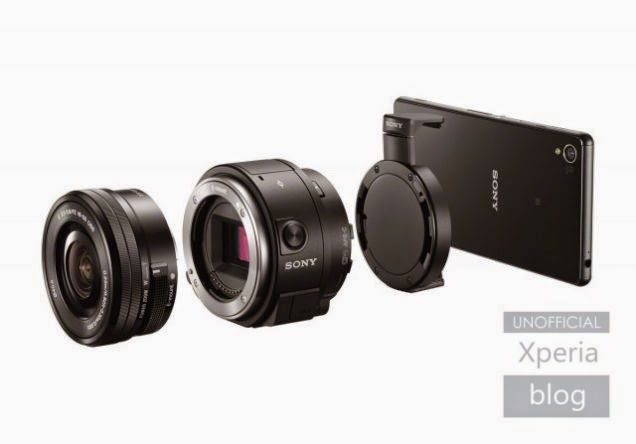

Just like the previous QX models, the QX100 and QX10, the smartphone becomes the LCD screen and UI that controls the potent hardware packed inside these two cameras. In the case of the QX1, the big boy of the bunch, that hardware includes a 20.1MP APS-C sensor, a BIONZ X processor, and even a pop-up flash. And, to sweeten the pot, the QX1 can shoot RAW.
The QX30, on the other hand, trades image quality for sheer reach. Packing a 20.4MP 1/2.3-inch sensor and bridge camera-worthy 30x 25-750mm equivalent f/3.5-6.3 lens, the QX30 will help keep the blur at bay with Sony’s Optical SteadyShot technology and can even extend your reach to 60x digitally. And once you’ve zoomed in on your far-away target, the QX30 can lock on AF and snap away at a blazing 10fps so you don’t miss the shot.
The QX30 will arrive in stores later this month and cost you $350, while the ‘body-only’ QX1 will join it in November with a suggested retail price of $400. To find out more about either of these cameras, head over to Sony’s press room by clicking here.
Android Fragmentation Report: Samsung on Top, Sony, LG Follow

We know that the Android ecosystem of devices is highly fragmented and thanks to a report by OpenSignal, it seems that the numbers have increased in a very short time. According to the latest Android fragmentation report, there have been about 18,796 different Android devices. This is a big increase over last year’s report of 11,868, marking a 60% growth year-on-year. Just two years back in 2012, individual Android devices stood at just 3,997.
According to the report, here are the most significant findings:
1. Samsung is still the leader and the company ranks highest in the number of available devices, has 43% of the total share and has 12 of the 13 most popular devices. The Galaxy S3 is on the top followed by the Galaxy S4 and Galaxy S5 along with the Note series
2. Sony is the second largest Android brand with 4.8% share with LG closely behind in the race
3. Even though they are widely considered to be the most popular Android devices this year, the Nexus 5 and Moto G are surprisingly behind a number of Samsung devices
4. Chinese brands including Huawei, ZTE, and Lenovo are all gaining momentum and a good share of the market
5. Android 4.4+ Kit Kat takes up 20.9% of all activated devices and almost 50% were on Jelly Bean. Which means 70% of Android devices are on the top two version of the operating system
6. There is a correlation between fragmentation and GDP/Capita. Countries having a GDP higher than $20,000 have less fragmentation than countries with GDP lower than that.
We
know that the Android ecosystem of devices is highly fragmented and
thanks to a report by OpenSignal, it seems that the numbers have
increased in a very short time. According to the latest Android
fragmentation report, there have been about 18,796 different Android
devices. This is a big increase over last year’s report of 11,868,
marking a 60% growth year-on-year. Just two years back in 2012,
individual Android devices stood at just 3,997.
According to the report, here are the most significant findings:
1.
Samsung is still the leader and the company ranks highest in the number
of available devices, has 43% of the total share and has 12 of the 13
most popular devices. The Galaxy S3 is on the top followed by the Galaxy S4 and Galaxy S5 along with the Note series
2. Sony is the second largest Android brand with 4.8% share with LG closely behind in the race
3. Even though they are widely considered to be the most popular Android devices this year, the Nexus 5 and Moto G are surprisingly behind a number of Samsung devices
4. Chinese brands including Huawei, ZTE, and Lenovo are all gaining momentum and a good share of the market
5.
Android 4.4+ Kit Kat takes up 20.9% of all activated devices and almost
50% were on Jelly Bean. Which means 70% of Android devices are on the
top two version of the operating system
6.
There is a correlation between fragmentation and GDP/Capita. Countries
having a GDP higher than $20,000 have less fragmentation than countries
with GDP lower than that.
- See more at:
http://www.digit.in/mobile-phones/android-fragmentation-report-samsung-rules-followed-by-sony-and-lg-23692.html#sthash.GKd8VjDi.dpuf


