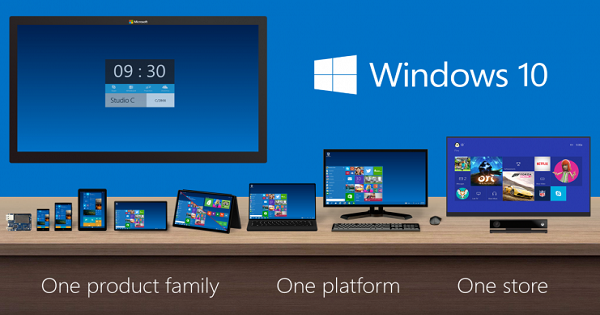
At its Windows event in San Francisco today, Microsoft announced the
next release of its operating system. Known until now as codename
Threshold, the successor to Windows 8 will officially be known as
Windows 10. Terry Myerson, Microsoft’s Executive Vice President of Operating
System, unveiled the name, after saying Windows is used by about 1.5
billion people. “Windows is at a Threshold and now it’s time for a new
Windows,” Myerson said at the event. “It wouldn’t be right to call it
Windows 9.”
The new operating system will offer a tailored experience for each
device, but a single store will offer apps and updates across all
devices. Windows 10 “will deliver the right experience on the right
device at the right time,” Myerson said.
The Start menu not only has live tiles, but you can resize them,
which impacts the overall size of the menu itself. You can also search
the Web and receive results without opening up a browser.
While showing off the new operating system, Joe Belfiore, Corporate
Vice President, Operating Systems Group at Microsoft, said today that
going from Windows 8 to Windows 10 is like going from a Prius to a
Tesla. “They don’t have to learn any new way to drive.”
Here Are Some Screen Starts :
Despite the focus on the mice and keyboard today, Microsoft will keep
the touch part of Windows 8 around. The argument here is that touch
users have higher satisfaction on Windows 8 devices than on Windows 7
devices. The opposite is true for mouse and keyboard users. As a result,
Microsoft wants businesses to think of Windows 10 as a merging of
Windows 7 and Windows 8.
“One of the most important customers for Windows is the enterprise,”
Myerson said at the event. Redmond is very interested in communicating
that it has been hard at work to move away from Windows 8, which many
have criticized for not being as easy to use with a mouse and keyboard.
The next version of Windows was widely expected to arrive sometime
next year. Even the Wi-Fi password at the event was chosen to remind
everyone of this: “Windows2015.”
BlackBerry has launched the BlackBerry Passport, the company’s latest high-end smartphone in India. It was unveiled
last week and packs a 4.5” diagonal (1440 x 1440 pixels) display with
Corning Gorilla Glass 3 protection, quad-core Snapdragon 800
(MSM8974-AA) processor and runs on BlackBerry OS 10.3 with new
BlackBerry Assistant, BlackBerry own personal assistant.
Blackberry keyboard also gets an update, with touch enabled keys
right above, on-screen. It has a 13-megapixel rear camera with LED
Flash, 2-megapixel front-facing camera and has 4G LTE connectivity. It
has 3GB RAM, 32GB of internal memory with expandable memory up to 64GB.
It comes pre-loaded with the Amazon appstore for all the Android app
needs while the Blackberry world app store will focus on enterprise
apps. We unboxed the BlackBerry Passport recently, check out the
unboxing.
BlackBerry Passport Specifications :
4.5-inch diagonal (1440 x 1440 pixels) 453 PPI 10-point multi-touch display with Corning Gorilla Glass 3 protection
13MP Auto-Focus rear camera with 6DOF OIS, BSI sensor, 5-element f2.0 lens, LED Flash 1080p HD video recording at 60fps
2MP Fixed-Focus front-facing camera with Image & video stabilization, 720p HD video recording
Dimensions: 128 x 90.3 x 9.3mm; Weight: 196g
3.5mm audio jack, FM Radio
3GB LPDDR3 800MHz RAM, 32GB internal memory, Expandable memory up to 64GB with microSD
4G LTE, WiFi 802.11 b/g/n (2.4GHz and 5GHz), Bluetooth 4.0 LE, SlimPort, NFC, GPS + GLONASS
3450mAh integrated non-removable battery
The BlackBerry Passport comes in Black and White colors and is priced
in India at Rs. 49,990. It is available for pre-booking at Amazon.in
and BlackBerry exclusive stores starting today, 29th September till
October 10th and goes on sale on October 10th. Those who are pre-booking
the smartphone on Amazon would get Rs. 5000 worth Amazon gift card and
5000 complimentary miles from Jet airways.
With a seemingly ever-growing number of streaming music services
available via the Web and dedicated mobile and tablet apps, choosing the
one that best fits your need is an increasingly difficult task.There are lots of options out there, but here are some of the biggest and most notable that are worth checking out.
Spotify
Spotify is one of the best-known music services available, and as
such it has a 20 million strong catalogue of tracks available to listen
to – it also means there’s a thriving hub of third-party apps too, like the BBC’s Playlister service among many other, with which to extend your listening.
Pandora
Although Pandora is still only available to users in the US,
Australia and New Zealand, it’s a veritable granddaddy of online music
streaming, but walks a different line to Spotify. Rather than providing tracks on-demand, Pandora users pick an song
and let it create a radio station of similar and related music.
Thankfully, and as you might expect given its the primary function, this
actually works pretty well and keeps recommendations sensible.
For a yearly payment of $36 or a monthly payment of $3.99, Pandora listeners can, however, upgrade to a Pandora One account, which removes all the advertising, and provides access to the service through the standalone Pandora One Desktop app.
Google Play Music All Access
OK, so it has an unwieldy and cumbersome name that we wish Google would change, and we’ve already given you a pretty deep dive into Google’s music service, but here are several good reasons it deserves consideration in your short list. Currently, there’s a 20,000 track limit on the number of songs you can
upload, but this should be enough for a modest music collection.
iTunes Radio
iTunes Radio is obviously, by its very nature of being tied to the largest digital music store, a big player in this list. Offering access from a range of [mostly Apple] devices, iTunes Radio
can be used on your iPhone, iPad, iPod touch, Mac, PC, or Apple TV and
allows seamless syncing of playlists between them. Like Amazon and Google’s music services, Apple also offers users the
option of storing all your locally stored music in iCloud via the iTunes Match service, so you can play it back from any compatible device. To use this feature, you’ll need a premium subscription to iTunes Match costing $24.99 per year.
Deezer
The French company Deezer has been offering music streaming since way
back in 2006, although back then it was called Blogmusik. It became a
fully fledged business in August 2007.
With many years under its belt already, Deezer is now a mature
service with a catalogue of 30 million tracks available for playback.
Like the others, at its most basic it offers playlists, music discovery,
favorites and integrated social features but it also offers a wide
range of different mobile clients including iOS, Android, Windows Phone 7
and BlackBerry. It’s also available on Mac/PCs too, as well as via a
dedicated Windows 8 app.
Xbox Music is Microsoft’s music streaming service that ties together its desktop, gaming, mobile and tablet devices for true multi-platform access, and a replacement for Zune.
It only launched last summer, but it’s already had a makeover for Windows 8.1 and launched on iOS, Android and via a Web player. Naturally, it’s available on Xbox consoles too.
SoundCloud
If you’re looking for a huge repository of music, but one that also
lets you upload your own mixes and tracks too, then you’re probably
looking for SoundCloud. Primarily intended platform for people to share their own musical
creations and mixes, as it has grown in popularity and size, big artists
and labels have also signed up, allowing for some of their music to be
available through the platform.
SoundCloud offers three pricing tiers:
Free – Offers two upload hours, 100 downloads, unlimited playlists
and access to some stats, like number of plays, downloads, comments and
favorites of tracks.
Pro (€3 per month/€29 per year) – Allows four hours of uploads,
access to posting tracks in ‘Quiet Mode’ (allowing you to control
comments) and Spotlight (allowing you to pin up to five tracks to the
top of your profile to receive more attention). It also includes more
detailed stats, with reports on who is playing your tracks and where
they’re located.
Pro Unlimited (€9 per month/€99 per year) – Allows you to upload
unlimited single sound file sizes up to 2GB each and within an upload
time limit of 30 hours per week.
Grooveshark
Grooveshark is an online music streaming service for playing back individual tracks, artists or albums since back in 2007. The free tier allows ad-supported listening of tracks across a wide range of genres, but it’s really the hassle-free listening and good selection of electronic dance music that scored it a place on this list.
Slacker Radio
Slacker is another radio-style
streaming service that’s available across a range of platforms, but
unlike, say, Pandora, listeners aren’t restricted to only being able to
listen to radio stations.
Sony Music Unlimited
Sony’s music streaming service, like many others, touts a catalog of
more than 25 million tracks (“from indies to superstars”) available to
play on demand, however, it’s a little different to some of the options
here, in that there’s no free streaming plan available. Instead, to entice you to dip a toe into the water, there is a free
30 day trial so you can take it for a test run before deciding to carry
on with monthly payments, or not. If you do decide to go ahead and pay
for it, the service has two tiers: an Access Plan and a Premium Plan.
It’s probably also worth mentioning that at the time of writing, there’s
also a 3-month offer for $3/£3.
The Access Plan is the cheaper of the two — $4.99/£4.99/€4.99 — and
allows users to access premium Channels, chart listings and editorial
playlists curated by the team. Naturally, it also includes unfettered
streaming access to the entire catalogue of tracks, or there’s the
option to download playlists to your library for offline access – but
only up to a limit of 1,000 tracks.
Mixcloud
Mixcloud touts itself as the place for long form audio. In
real terms, this means that it’s a great repository for DJ mixes, radio
shows, podcasts and any other longer audio formats. The company says
that the average length of an upload on its platform is in excess of 40
minutes, and that the average listener stays tuned in for more than 20
minutes, and its long form format means it’s great at just running
unattended in the background for hours at a time.
Rdio
Rdio is an ad-free music subscription service that allows users to
listen to music on-demand, as well as to stream pre-made stations and
playlists of tracks created by other users. Like many of the others, Rdio claims to have that magic 20 million
song catalog and offers mobile access for iOS, Android, Windows Phone
and BlackBerry devices (via a Web app). Although you’ll need to pay a
monthly subscription fee for access from a mobile.
For $4.99/£4.99 per month, you can get access to unlimited streaming on
the Web, shown above. Increasing this to $9.99/£9.99 broadens access to
include mobile devices (Windows Phone shown below) and streaming via
devices like a Roku media player. There’s also a family plan which includes two (by default, although more can be added) unlimited subscriptions starting from $17.99/£17.99 per month.
TuneIn Radio
TuneIn Radio is a little different to the other radio streaming
services in this list as it focuses on acting as a hub and player for
commercially available radio shows. In total, there are more than
100,000 live stations available, and more than 2 million podcasts. There is actually a chargeable app for iOS (currently $0.99, but usually $6.99) and Android
($6.99) that allow users to record live radio, but still won’t get you
out of listening to those adverts. There are also free apps for Android
and iOS too. It’s also available for Windows Phone, BlackBerry, some Roku players, through some Internet TVs – and even directly in some cars.
Myspace (Music)
MySpace might seem
like an odd one in this list, but since it relaunched, it has re-angled
itself as a music and video platform, rather than as a social network.
Beats Music
Beats Music is easily the newest service on this list, so new in fact that it hasn’t even quite started up yet anywhere, but it will on January 21. However, only for users in the US – although further expansion is to be expected, judging from the signup page for people outside the States.
Amazon
Amazon is clearly the elephant in the room when it comes to this, as it doesn’t offer a music streaming service. Yet. However, we’d be surprised if it didn’t offer one in the future.
Round up
As you can see, there are plenty of online streaming options
available, with some being more suited to radio listening and others
focusing purely on providing individual tracks and albums on-demand.
Most of those included in this list offer an algorithm or human
curation aspect to discovery of new music, but you’ll likely need to
spend some time using any of them before it accurately learns what you
like.
In July, Finnish smartphone company Jolla announced that it planned to enter the Indian markets
with Sailfish OS-powered devices. The company even sent out a tweet
from its official account confirming the India launch alongside an
exclusive tie-up with Snapdeal. Two months later, the device has finally
reached Indian shores and will be available for purchase exclusively
via Snapdeal for Rs 16,499. The phone is available in Poppy Red, Keira
Black and Aloe colours.
The Jolla smartphone features a distinct button-less design, and the
Sailfish OS gesture-based user experience. Sailfish OS is based on
Meego, a Linux-based mobile operating system that Nokia had been working
on. It was later put on hold as it wanted to focus on Windows phones.
Former Nokia employees revisited the project to bring the Jolla
smartphone which runs on Sailfish OS. The Sailfish UI’s biggest
strengths includes focus on multi-tasking without jumping in and out of
apps. As is becoming the norm nowadays, there is also a big emphasis on
gestures for navigation and selection of content.
Jolla integrates Android apps so users can enjoy a majority of apps
that are popular on Android. Other features include Live multitasking,
which lets users use multiple apps simultaneously and a unique interface
that supports new gestures such as peek and pull. The Home view shows
you commonly-used apps, while app shortcuts can be accessed with a
swipe. For example for switching music tracks and opening a new browser
window.
The phone sports a 4.5-inch 960 x 450 display, 8 MP main camera and a
2MP front camera and packs 16GB of built-in storage. The phone is
powered by a dual-core Qualcomm Snapdragon processor, which is clocked
at 1.4 GHz and backed by 1GB RAM. There’s a user-replaceable 2100 mAh
battery, which Jolla claims, provides up to 10 hours of call time.
Interestingly, today is the day when Xiaomi will be selling 60,000 Redmi 1 s units on Flipkart,
so looks like both Snapdeal and Flipkart will be enjoying the limelight
today. However, unlike, the hordes of budget-phone makers entering the
Indian market, the Jolla smartphones comes at a slightly higher price
tag of Rs 16,499.
With its iPhone 6
announcement completed, Apple reportedly is preparing a second
announcement event that will will launch new iPad models, claims AppleInsider,
citing a trusted insider familiar with the company's pre-launch
logistics. The report points to the second half of October for the
event, but The Daily Dot has gone a step further and predicted an October 21 event based on its own sources.
A
person familiar with the company's pre-launch logistics says Apple has
set internal project and marketing deadlines of mid-October, ahead of
the planned unveiling of major new products during the second half of
the month. That would align with an anticipated media event previously
rumored to be held at some point during October. The same source who
spoke to AppleInsider has shared reliable information on product
introduction and timing in the past.
If true, the schedule
would align with Apple's pattern for the last several years, which last
year saw the company unveil its new iPad Air and iPad mini with Retina
display in October with an availability date in early November. This
year's event may introduce updated iPad models that include a faster A8
processor, anti-reflective display and a Touch ID fingerprint sensor, although one report suggests most of the upgrades will be limited to the larger iPad Air model.
Aside from new iPads, Apple is also expected to use the October event to
finalize the details and availability date for OS X Yosemite, which was
initially introduced at the company's Worldwide Developers Conference
in June. According to The Daily Dot, Yosemite will be released
immediately following the October event, similar to the release of OS X
Mavericks just after the conclusion of last year's October event.
Other Apple devices in need of upgrades include the Mac mini, MacBook
Air, iMac, and the Apple TV, but few details suggest updated these
models will be updated before the end of 2014, particularly given
Intel's delays with its next-generation Broadwell processors. One recent
rumor has, however, claimed Apple may release a new ultra-high
definition 27-inch monitor with 5120 x 2880 resolution in 2014, but
details on this desktop accessory remain sparse.
Apple
Inc. will unveil the next generation of iPad tablets around
mid-October, a person with knowledge of the plans said, as the company
bolsters its product lineup ahead of the holiday shopping season.
The
report reiterates earlier claims that new iPad and iPad mini are
already in production or soon to be so, while a larger 12.9-inch iPad is
scheduled to begin mass production early next year.
It looks like a standard SD card, but SanDisk's new Extreme PRO
SDXC UHS-I memory card is noteworthy — by packing 512GB into its flat
frame, it's the highest capacity SD card
available to consumers. The company says the huge card is aimed at
pro-level photographers and videographers who want to shoot in 4K
definition.
The luxury of extra storage does not come cheap, however. SanDisk's
priced the 512GB SD card at $799, which could end up being less from
retailers and through online stores. To put that in perspective, SanDisk
currently charges $338.99 for the much smaller 64GB SD card with the same features, something you can find for less than $100 from numerous online retailers.
Lexar released the first 256GB SD card onto the market in 2012, but
SanDisk has made an effort recently to give its products the most
storage space, launching two biggest-in-class memory cards this year. In
February, the company released the world's largest microSD card,
with 128GB of storage in its tiny 15mm by 11mm body. As it launched its
latest 512GB model, SanDisk touted the fact it had increased SD storage
1,000-fold in just over a decade. Its first SD card, released in 2003,
had a paltry 512MB of space.
This is the first time I can remember that PC gaming was mentioned at
the Intel Developer Forum (IDF) without me having to remind an exec
that we existed. Unprompted, Intel's Kirk Skaugen took to the stage in
the main keynote proclaiming “desktop is alive and well. It's
innovating, whether it's small form factors, all-in-ones, portable
all-in-ones or extreme gaming. There are 711 million PC gamers in the world today, that's one in ten people on the planet,” he enthused.
Skaugen was talking up their new Broadwell processors,
coming our way early next year. They're Intel's first 14nm product
based on the Haswell microarchitecture. Simply put,” he said, “this 14nm
technology is the most advanced silicon manufacturing technology in the
world.”
But it's not simply the die-shrink that's going to be
important for Broadwell as Intel is really pushing forward the processor
graphics of its next CPUs.
That's interesting because, for the first time, Intel is going to be
slotting their top Iris Pro GPU component into a socketed processor.
That means you should be able to buy an Iris Pro-based processor and
drop it into a cheapo mini-ITX H97 motherboard to make an affordable
mini gaming PC. Of course you can already get a small form factor
PC with the likes of the NUC and Gigabyte's Brix Pro, but those are
super-expensive products. I'm hoping that Intel shifts the Iris Pro down
into the more affordable i5 processor ranges, but they are not able to
say yet what from those chips are going to take.
Unfortunately
it's likely to remain a differentiator for Intel's K-series processors,
even down at the Core i5 level. That still means potential for a far
more affordable, teensy 1080p gaming PC than ever before.
“We're
really focused around PC gaming and enthusiasts. This is the one area of
PCs that has kept growing,” Intel's Lisa Graff told me at the show.
“These are out most loyal customers: PC gamers. They want as much
performance as we can throw at them. We're going to bring Intel's best
technologies to bear for PC gaming.”
It’s just gone official. The “first affordable flagship,” the Nokia
Lumia 830, has been announced at IFA 2014 by Microsoft’s Devices and
Services group. The device features an impressive camera and pretty
decent specs for quite the affordable price.
It comes with Windows Phone 8.1, Microsoft Office, OneDrive, Cortana,
and more. Microsoft is up-playing the fact that Windows Phone 8.1
allows for much customization to the interface like with the new
“Glance” lock screen.
Microsoft has developed a new screen sharing
accessory that operates with NFC-enabled Lumia devices to let you
project your screen to the big screen. It has a really long name, as
those Redmond people just had to call it Microsoft Screen-Sharing for Lumia Phones HD-10. Nokia Lumia 830 Specifications :
Main camera sensor: 10 MP, PureView
Display size: 5''
Display resolution: HD720 (1280 x 720)
Processor name: Snapdragon 400
Maximum talk time (3G): 14.8h
Battery capacity: 2200mAh
Wireless charging: Built-in (Qi standard)
Dimensions
Height: 139.4 mm
Width: 70.7 mm
Thickness2: 8.5 mm
Weight: 150 g
Display and User Interface
Display size: 5 ''
Display resolution: HD720 (1280 x 720)
Display features: Brightness control, Nokia Glance screen, Sunlight
readability enhancements, Corning® Gorilla® Glass 3, Easy to clean, High
brightness mode, Lumia Color profile, Sculpted glass, Wide viewing
angle, Double-tap to wake
NFC: Pairing, Secure NFC for payment, Sharing, Tagging
Other wireless connectivity: Wi-Fi Channel bonding, Screen projection
Productivity features
Personal information management features: Calculator, Clock, Calendar,
Alarm clock, Reminders, Phonebook, To-do list, Family Room, Kid's
Corner, OneNote, Social networks in Phonebook, Wallet, Notifications
Business apps: Lync (Corporate IM) free download, Company Hub for
enterprise applications, Office apps: Excel, Word, PowerPoint, OneNote,
OneDrive storage for documents and notes, Adobe Reader free download
Document formats supported: PDF, Word, Excel, OneNote, PowerPoint
Sync type: Exchange ActiveSync, Via Windows Phone apps, Nokia Photo Transfer for Mac
Sync content: Calendar, Video, Pictures, Music, Contacts.
Email and Messaging
Email clients: Gmail, Nokia Mail, MS Exchange Active Sync, Windows Live /
Hotmail / Outlook.com, Yahoo! Mail, IBM Notes Traveler, Outlook /
Office 365 / Exchange
Email protocols: SMTP, IMAP4, POP3
Email features: Viewing and editing of email attachments, Multiple email
accounts, HTML emails, Inbox filtering, Text-to-speech message reader,
Conversational view on email, Linked inboxes, Word flow keyboard
Messaging features: Text messaging, Automatic resizing of images for
MMS, Distribution lists for messaging, Multimedia messaging,
Conversational chat style SMS, Unified inbox for SMS and MMS,
Concatenated SMS for long messages, Integrated text messaging and chat,
Number screening for messaging, Text-to-speech message reader.
Security
Enterprise security features: Mobile VPN, Remote lock and wipe, Hardware
accelerated device encryption, Mobile device management, Remote
security policy enforcement
General Security features: Device lock, PIN code, Device lock passcode,
Regular signed firmware updates, Track and Protect via internet,
Application certification, Application sandboxing, Backup and restore
via Internet, Browser integrated anti-phishing, Remote device lock via
Internet, Remote device wipe via Internet, Secure boot, Signed OS,
Consumer VPN
Supported security standards: TLS v1.0, TLS v1.1, TLS v1.2, SSL v3.0, Suite B ciphers
GPS and navigation
Location and navigation apps: HERE Drive+, HERE Maps, HERE Transit, Local Scout
Navigation features: Public transportation routing guidance, Free maps,
Offline maps, Augmented reality with LiveSight, Automatic day/night view
switching, Download the latest maps with Wi-Fi, Fast search with
type-ahead suggestions, Find upcoming departure times, Free global voice
guided turn-by-turn drive navigation, Live traffic information, Online
and offline favourites, Pin places to Start screen, Speed limit
warnings, Venue maps - shopping and transport centers
Video white balance modes: Cloudy, Fluorescent, Incandescent, Automatic, Daylight
Browsing and Internet
Internet browser capabilities: Internet Explorer 11
Social apps: Facebook, LinkedIn, Twitter, WhatsApp
Photo sharing: Facebook, Send as email attachment, Share over Bluetooth,
Flickr, Picasa, Tap and share images or videos with NFC, Nokia Beamer,
OneDrive, Share on TV with Nokia Play To DLNA app
Video sharing: Video sharing to social network and internet, Facebook,
Flickr, Joyn video call sharing, OneDrive, Picasa, Share on TV with
Nokia Play To DLNA app, Video sharing with NFC, YouTube
The Lumia 830 comes in bright orange, bright green, white and black
colors and would roll out globally starting this September at estimated
to be priced of 330 Euros (Rs. 26,220 / US$430 approx.) before taxes and
subsidies.
Asus announced a few more devices including MeMO Pad 7 ME572 Android tablet, Zenbook UX305 QHD+ ultrabook and Asus Eee PC.
First up is the MeMO Pad 7 ME572. The tablet runs Android 4.4 KitKat and is powered by a quad-core Intel processor along with 2GB of RAM. The MeMo Pad has a 7-inch 1920 x 1200 pixel display. It sports 5MP rear camera, and 2MP front-facing camera. The Asus MeMO Pad 7 ME572 supports 3G, 802.11n WiFi and Bluetooth 4.0 for connectivity.
The Zenbook UX305 has a 13.3-inch display with 3200 x 1800 pixels resolutions. It is powered by an Intel Core M processor and features a 256GB solid-state drive. The ultrabook weighs in around 1.2kg. Other features are Other aspects USB 3.0 ports, SD card reader, micro-HDMI, and 802.11ac WiFi connectivity.
The new Asus EeeBook X205 runs full version of Windows 8.1. The 11.6-inch laptop is powered by a quad-core Intel Atom T3735 Bay Trail CPU along with 2GB of RAM. The Asus EeeBook X205 is available in 32GB and 64GB storage versions. For connectivity, it supports Bluetooth 4.0, Wi-Fi.
Asus announced a few more devices including MeMO Pad 7 ME572 Android tablet, Zenbook UX305 QHD+ ultrabook and Asus Eee PC.
First
up is the MeMO Pad 7 ME572. The tablet runs Android 4.4 KitKat and is
powered by a quad-core Intel processor along with 2GB of RAM. The MeMo
Pad has a 7-inch 1920 x 1200 pixel display. It sports 5MP rear camera,
and 2MP front-facing camera. The Asus MeMO Pad 7 ME572 supports 3G,
802.11n WiFi and Bluetooth 4.0 for connectivity.
The
Zenbook UX305 has a 13.3-inch display with 3200 x 1800 pixels
resolutions. It is powered by an Intel Core M processor and features a
256GB solid-state drive. The ultrabook weighs in around 1.2kg. Other
features are Other aspects USB 3.0 ports, SD card reader, micro-HDMI,
and 802.11ac WiFi connectivity.
The
new Asus EeeBook X205 runs full version of Windows 8.1. The 11.6-inch
laptop is powered by a quad-core Intel Atom T3735 Bay Trail CPU along
with 2GB of RAM. The Asus EeeBook X205 is available in 32GB and 64GB
storage versions. For connectivity, it supports Bluetooth 4.0, Wi-Fi.
- See more at:
http://www.digit.in/tablets/ifa-2014-asus-unveils-memo-pad7-zenbook-ux305-and-eeebook-x205-23819.html#sthash.zvuKAsNk.dpuf
Lenovo gave us a good look at another addition to its line-up of laptops, the Y70 Touch. The company claims that the Y70 Touch gaming laptop is its first 17-inch touch device.
The
Y70 Touch gaming laptop comes in three variants and is available to buy
from Lenovo’s US online store. The three models – 80DU000EUS,
80DU000NUS, and 80DU000HUS – are priced at $1,399.99, $1,499.99 , and
$1,689.00 respectively. Lenovo also said that the laptops will be
available with major retailers in October.
The only fact that may not go down well with its prospective buyers is
its weight; the Lenovo Y70 Touch laptops weigh a hefty 3.4kgs.
The three models of the
Y70 Touch gaming laptops are powered by the fourth-generation Intel Core
i7-4710HQ Processor (2.50GHz, 4 cores, 8 threads, 6MB cache).
The difference between the three variants is in system memory, dedicated
GPUs, and in-built storage. All three models of the Lenovo Y70 Touch
run Windows 8.1 64-bit OS and sport a 17.3-inch full-HD LED anti-glare
multi-touch display. An integrated HD (720p) webcam is also included.
The
three Lenovo Y70 Touch laptop variants also share the connectivity
features including Bluetooth 4.0 and Wi-Fi 802.11 ac/b/g/n, as well as
the same battery – a 4-cell 54-Watt Hour Li-Po. Sized at
422.9×290.6×25.9mm, the Lenovo Y70 Touch laptops boast stereo speakers
powered by JBL alongside a backlit keyboard for easy typing during low
light conditions.
With new apps and interactive sites, science
class, in particular, has received a few upgrades. We took a look at
how science technology has evolved over time, and what adjustments have
been made.
1. A life-size plastic replica of a skeleton in class vs. an interactive skeleton app
Anatomy teachers loved that life-sized plastic skeleton model hanging in
the back of the classroom. But with the overwhelming number of medical
apps available, students now have the option to download free tools like
Essential Skeleton 4 to visualize and learn about the the skeleton system.
2. Science fair presentation boards vs. online self-publishing tools
With video-sharing sites like YouTube
and blogging platforms like Glogster, students no longer need scissors
and glue to craft a project. These web tools allow students to create
interactive projects that combine text, audio, pictures and videos.
3. The Periodic Table of Elements poster vs. interactive tables full of information
Today, whole sites are dedicated to interactive periodic tables. On Ptable.com,
hover over an element and learn about its properties, click on it to
access the Wikipedia page, use the slider to view elemental changes in
temperature.
4. Real frog dissection vs. virtual frog dissection
You no longer need a scalpel to explore the anatomy of a frog, or any other organism. Ick.
5. Microscopes vs. smartphone microscopes
The microscope is still the same, but now there is a device that
allows students to use their smartphones to capture photos through the
microscope eyepiece.
Skylight,
a $75 plastic smartphone-to-microscope adapter, allows students to
magnify insects, pathogens and more. It also can be attached to
telescopes, binoculars and spotting scopes. The product was cofounded by
Tess Bakke and Andy Miller and was successfully funded in 2012 on Kickstarter.
6. Paper and pencil quizzes vs. clicker quizzes
Today, interactive tech instruments like clickers are being used in
science lectures and other classes for quizzing and polling.
7. Hands-on chemistry experiments vs. virtual chemistry experiments
No test tube? No problem. Just experiment with your computer.
According to the BBC and The Atlantic, Google has been secretively working on creating delivery drones called “Project Wing.” The project is a part of the Google X labs
whom have also conjured up Project Loon, Glass, driverless cars and
much more. Now Google has officially given us a look at what they’ve
been working on.
Project Wing is a tail sitter unmanned aircraft
— a hybrid between a plane and a helicopter that can take off without
using a runway and lands vertically. The drone flies like a plane, but
more importantly, it can hover and lower a package to the ground by wire
before releasing it. The vehicle has a five-foot wingspan with four electrically-driven
propellers and weighs just under 19 pounds — the total weight of the
craft and the item it will delivering can only be 22 pounds — sad to
say, but you can’t order your 30 pound iMac with a Project Wing drone.
Google says these vehicles can be used for delivering goods, but the
project’s primary focus is to use these drones in the event of disaster
relief scenarios — delivering supplies to those who urgently need them.
“Even just a few of these, being able to shuttle nearly continuously
could service a very large number of people in an emergency situation,”
Google X’s Astro Teller told the BBC. However, if you can’t wait for them to come out and are an interested partner, Google has a sign-up sheet available.
The test flight took place in Australia, and there’s way more testing
and regulatory obstacles to overcome before anyone can receive packages
in this method. It’s not the first time a drone-based delivery system has been introduced, last year a company called SF Express in China were testing drones for transporting packages.
While developing the project,
Google found that people wanted to grab the packages from the drone,
which could have injured them because of the tiny propellers. That's
where the design for the package delivery by string came from, which was
designed by a one of Google's mechanical engineers. The string is
actually fishing line, while the small grip is called the "egg."
Google envisions a system that
is controlled in part by computers as well as people. Controllers will
be able to oversee what the drones are doing and take control. That
could be useful in cases where packages could get stuck. And Google says
it plans to use some of those human interactions to help improve the
automated software, like it's done with its self-driving car program.
Microsoft's anticipated next version of Windows, expected to be
called Windows 9 and officially codenamed Threshold, has once
again come under the spotlight with reports pointing to new features
such as interactive live tiles and notification centre, said to be a
part of Modern UI 2.0. Also being actively speculated about is the
separation of desktop from Modern UI, the release-cadence cycle of the
new operating system, and the expected release of Windows 9 technical
preview as early as next month.
Winbeta reports
that Microsoft would modify Windows 9 to offer different features on
different form factors. ARM-based Windows RT Threshold tablets (as well
as smartphones, with the unifying Threshold update) will in most cases
barring a few exceptional devices feature the Modern UI only, with no
way to switch to the desktop mode or use regular Win32 applications.
On
the other hand, laptops, desktops and AIOs would feature only the
desktop mode, with the new Start Menu the only place where desktop users
will be able to interact with the Modern UI and its apps - the Start
Menu is also said to be expandable to full screen to become like the
Start Screen.
The website also reports two new features for the
Start Screen and Start Menu, namely interactive Live Tiles and a new
Notification Centre. The interactive Live Tiles will enable users to
perform certain tasks on the app without opening it.
The first glimpse
of the interactive Live Tile was seen in April.
Winbeta notes that not all apps will have interactive Live Tiles
functionality, though most important ones will, and that developers will
have to make sure their apps support the interface. The website
also adds that the Modern UI 2.0 included in the Windows Threshold will
also feature a Windows Phone 8.1-like Notification Centre. The details
on the feature are still scarce. In addition, Cortana might also have a
dedicated Live Tile on the start screen - just like on Windows Phone.
Winbeta says it is still uncertain if Cortana can be accessed via the
hardware search button or not.
While these two features are said
to reach the users as a part of Windows 9 or Threshold, Winbeta says
because of the rumoured separation of Modern UI from the desktop mode,
Microsoft may not release a Windows RT Threshold technical preview this
year - though it once again notes the uncertainly to this expectation. A
separate ARM-based Windows RT Threshold technical preview is expected
to be released after the x86-based Windows 9 Threshold technical preview
for enterprises, which could be released as soon as next month.Foley says it is still
unclear whether Microsoft will employ a subscription-based model to
deliver the updates, or just provide them for free while mitigating
development costs with other paid subscriptions. Of course, a very fast
cadence for updates will not make enterprises or IT managers very happy,
who'd prefer to test new versions and features before rolling them out
to their users.
A news report indicated
that Microsoft is planning to hold
an event on September 30 to provide a look at a version of what is
expected to be called Windows 9, and is thought to be codenamed
'Threshold'. The introduction will be aimed at developers behind
programs designed for computers powered by Windows software, and
Microsoft is expected to release a developer preview
as early as October before releasing a public preview by the end of the
year.
We know that the Android ecosystem of devices is highly fragmented and thanks to a report by OpenSignal, it seems that the numbers have increased in a very short time. According to the latest Android fragmentation report, there have been about 18,796 different Android devices. This is a big increase over last year’s report of 11,868, marking a 60% growth year-on-year. Just two years back in 2012, individual Android devices stood at just 3,997.
According to the report, here are the most significant findings:
1. Samsung is still the leader and the company ranks highest in the number of available devices, has 43% of the total share and has 12 of the 13 most popular devices. The Galaxy S3 is on the top followed by the Galaxy S4 and Galaxy S5 along with the Note series
2. Sony is the second largest Android brand with 4.8% share with LG closely behind in the race
3. Even though they are widely considered to be the most popular Android devices this year, the Nexus 5 and Moto G are surprisingly behind a number of Samsung devices
4. Chinese brands including Huawei, ZTE, and Lenovo are all gaining momentum and a good share of the market
5. Android 4.4+ Kit Kat takes up 20.9% of all activated devices and almost 50% were on Jelly Bean. Which means 70% of Android devices are on the top two version of the operating system
6. There is a correlation between fragmentation and GDP/Capita. Countries having a GDP higher than $20,000 have less fragmentation than countries with GDP lower than that.
We
know that the Android ecosystem of devices is highly fragmented and
thanks to a report by OpenSignal, it seems that the numbers have
increased in a very short time. According to the latest Android
fragmentation report, there have been about 18,796 different Android
devices. This is a big increase over last year’s report of 11,868,
marking a 60% growth year-on-year. Just two years back in 2012,
individual Android devices stood at just 3,997.
According to the report, here are the most significant findings:
1.
Samsung is still the leader and the company ranks highest in the number
of available devices, has 43% of the total share and has 12 of the 13
most popular devices. The Galaxy S3 is on the top followed by the Galaxy S4 and Galaxy S5 along with the Note series
2. Sony is the second largest Android brand with 4.8% share with LG closely behind in the race
3. Even though they are widely considered to be the most popular Android devices this year, the Nexus 5 and Moto G are surprisingly behind a number of Samsung devices
4. Chinese brands including Huawei, ZTE, and Lenovo are all gaining momentum and a good share of the market
5.
Android 4.4+ Kit Kat takes up 20.9% of all activated devices and almost
50% were on Jelly Bean. Which means 70% of Android devices are on the
top two version of the operating system
6.
There is a correlation between fragmentation and GDP/Capita. Countries
having a GDP higher than $20,000 have less fragmentation than countries
with GDP lower than that.
- See more at:
http://www.digit.in/mobile-phones/android-fragmentation-report-samsung-rules-followed-by-sony-and-lg-23692.html#sthash.GKd8VjDi.dpuf
Intex has launched Cloud FX, the company’s first smartphone running on Firefox OS, as it promised back
in June. It has a 3.5-inch HVGA screen, powered by a 1GHz processor,
has a 2-megapixel rear camera and comes with dual SIM support, similar
to the Firefox reference design that was unveiled earlier this year. It
has 2G (EDGE) connectivity.
The Firefox OS is based on HTML5, has Adaptive App Search or the
Single Window Search and comes pre-loaded with Facebook, Twitter and
more apps. It also has Firefox marketplace to download more apps. Spice launched the Spice Fire One Mi-FX 1, it’s first Firefox OS smartphone last week priced at Rs. 2,299.
Intex Cloud FX Specifications
3.5-inch (320 x 480 pixels) HVGA capacitive touch screen
Firefox OS
1 GHz Processor
128MB RAM, 46MB internal memory, expandable memory with microSD
Dual SIM (2G + 2G)
Dimensions: 115.9x62x11.8mm; Weight: 104g
2MP rear camera
2G (EDGE), Wi-Fi, Bluetooth
1250mAh
The Intex Cloud FX comes in black and white colors and is priced at
Rs. 1,999. It is available for purchase exclusively on Snapdeal. It
comes with 1GB of free data from Aircel per month for
three months. Aircel subscribers can SMS ‘INTEX’ to 121 to avail the
offer.
A study by InMobi has revealed that Indians are willing to pay between
Rs 71 and Rs 129 for in-app purchases. This comes as a relief to
developers who were doubtful whether it's possible to monetise their
creations in the market.
21% of the respondents who
participated in the InMobi survey said they had paid for in-app
purchases for messaging software, while 18% said they would not mind
spending some spare change for extras.
Line claimed to have
earned $27.4 million from emoticons and stickers bought by its Japanese
users in 2013. As Indian users are not keen on such features, the
developers of WhatsApp and similar services will have to find other
means of making money from their creations if they offeri in-app
purchases in the future.
Today we live in a world filled with quad-core smartphones and handsets with 1080p screens,
but it certainly didn’t start out that way. The first smartphone was
announced at COMDEX on November 23rd of 1992, making last Friday the
smartphone’s 20th birthday.
The IBM Simon Personal Communicator was a massive device with a
battery guzzling design, and its processor was quite laughable by
today’s standards at just 16MHz. Other specs included a 4.5-inch B&W
160×293 LCD display, stylus support for touch input, 1MB of RAM, 1 or
1.8MB memory card support, and a nickel-cadmium battery. Other
capabilities included the ability to make phone calls, add contacts,
task lists, check “mail” and use third party apps. When it came to
installing new apps? You did that using special PCMCIA cards through the
bottom of the device.
The IBM Simon Personal Communicator would finally arrive to the
market in 1994 for BellSouth (Now AT&T) customers in their 15-state
network and cost $899 with a two-year contract. By the time the phone
was being phased out of the market, it had dropped to $599 and had
managed to sell about 50,000 handsets after around six months on the
market.
Looking back at this ancient smartphone, it’s hard not to laugh a
little, though at the time it likely served its user quite well. In
IBM’s defense, this was certainly an impressive device back in 1994 and
in many ways it is still somewhat similar to the basic idea of what a
smartphone is today: a touchscreen device that works with apps to help
make our everyday lives easier.