


Showing posts with label technology. Show all posts
Microsoft Announces Windows 10
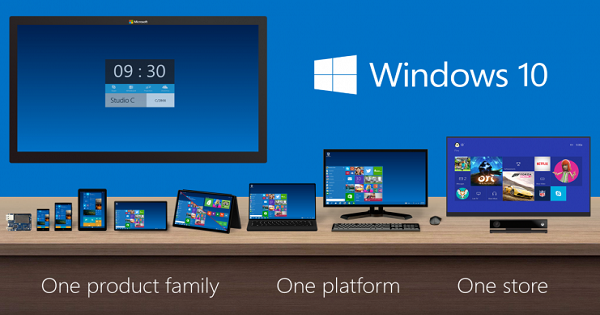
At its Windows event in San Francisco today, Microsoft announced the next release of its operating system. Known until now as codename Threshold, the successor to Windows 8 will officially be known as Windows 10. Terry Myerson, Microsoft’s Executive Vice President of Operating System, unveiled the name, after saying Windows is used by about 1.5 billion people. “Windows is at a Threshold and now it’s time for a new Windows,” Myerson said at the event. “It wouldn’t be right to call it Windows 9.”
The new operating system will offer a tailored experience for each device, but a single store will offer apps and updates across all devices. Windows 10 “will deliver the right experience on the right device at the right time,” Myerson said.
The Start menu not only has live tiles, but you can resize them, which impacts the overall size of the menu itself. You can also search the Web and receive results without opening up a browser.
While showing off the new operating system, Joe Belfiore, Corporate Vice President, Operating Systems Group at Microsoft, said today that going from Windows 8 to Windows 10 is like going from a Prius to a Tesla. “They don’t have to learn any new way to drive.”
Here Are Some Screen Starts : 


Despite the focus on the mice and keyboard today, Microsoft will keep the touch part of Windows 8 around. The argument here is that touch users have higher satisfaction on Windows 8 devices than on Windows 7 devices. The opposite is true for mouse and keyboard users. As a result, Microsoft wants businesses to think of Windows 10 as a merging of Windows 7 and Windows 8.
“One of the most important customers for Windows is the enterprise,” Myerson said at the event. Redmond is very interested in communicating that it has been hard at work to move away from Windows 8, which many have criticized for not being as easy to use with a mouse and keyboard.
The next version of Windows was widely expected to arrive sometime next year. Even the Wi-Fi password at the event was chosen to remind everyone of this: “Windows2015.”
Meet Matchstick, Mozilla's $25 Chromecast Alternative

Mozilla is expanding beyond its Firefox browser and trying its hand in the suddenly hot streaming video business.
Its take: the MatchStick HDMI streaming stick, which will sell for a limited time through Kickstarter at a starting price of $12 before it goes to retail. It's final price of $25 sets its sights on the Chromecast, the $35 streaming dongle from search giant Google. Matchstick runs on Firefox OS, the open source mobile operating system built by Mozilla on Firefox's underlying engine.
Mozilla has a keen interest in being known for more than just an Internet browser. The nonprofit Web advocacy organization receives a vast majority of its funding from Google, which also offers a competing browser in Chrome. Over the last two years, Mozilla has diversified into smartphones with its Firefox OS and now Matchstock in the hopes of getting support for open Web standards into more devices and more hands.
However, the Matchstick enters an already competitive field. Beyond the Chromecast, the streaming media space is crowded with Amazon's Fire TV, and market leaders Apple TV and Roku, all of which have long since secured the kinds of content partnerships such as Netflix and Hulu essential to the success of any entrant in the field. While Matchstick is promising to have them by its January launch, it doesn't appear to have secured them yet.
Graphene May Allow For Flexible, Low-cost Touchscreens

New research published today in the journal Advanced Functional Materials suggests
that graphene-treated nanowires could soon replace current touchscreen
technology, significantly reducing production costs and allowing for
more affordable, flexible displays.
The majority of today's touchscreen devices, such as tablets and
smartphones are made using indium tin oxide (ITO) which is both
expensive and inflexible. Researchers from the University of Surrey and
AMBER, the materials science centre based at Trinity College Dublin have
now demonstrated how graphene-treated nanowires can be used to produce
flexible touchscreens at a fraction of the current cost.
Using a simple, scalable and inexpensive method the researchers produced hybrid electrodes, the building blocks of touchscreen technology, from silver nanowires and graphene. Dr Alan Dalton from the University of Surrey said, "The growing market in devices such as wearable technology and bendable smart displays poses a challenge to manufacturers. They want to offer consumers flexible, touchscreen technology but at an affordable and realistic price. At the moment, this market is severely limited in the materials to hand, which are both very expensive to make and designed for rigid, flat devices."
Lead author, Dr Izabela Jurewicz from the University of Surrey commented, "Our work has cut the amount of expensive nanowires required to build such touchscreens by more than fifty times as well as simplifying the production process. We achieved this using graphene, a material that can conduct electricity and interpret touch commands whilst still being transparent."
Co-author, Professor Jonathan Coleman, AMBER, added, "This is a real alternative to ITO displays and could replace existing touchscreen technologies in electronic devices. Even though this material is cheaper and easier to produce, it does not compromise on performance."
"We are currently working with industrial partners to implement this research into future devices and it is clear that the benefits will soon be felt by manufacturers and consumers alike."
The research benefitted from funding and collaboration with M-SOLV, a touchscreen manufacturer.
Using a simple, scalable and inexpensive method the researchers produced hybrid electrodes, the building blocks of touchscreen technology, from silver nanowires and graphene. Dr Alan Dalton from the University of Surrey said, "The growing market in devices such as wearable technology and bendable smart displays poses a challenge to manufacturers. They want to offer consumers flexible, touchscreen technology but at an affordable and realistic price. At the moment, this market is severely limited in the materials to hand, which are both very expensive to make and designed for rigid, flat devices."
Lead author, Dr Izabela Jurewicz from the University of Surrey commented, "Our work has cut the amount of expensive nanowires required to build such touchscreens by more than fifty times as well as simplifying the production process. We achieved this using graphene, a material that can conduct electricity and interpret touch commands whilst still being transparent."
Co-author, Professor Jonathan Coleman, AMBER, added, "This is a real alternative to ITO displays and could replace existing touchscreen technologies in electronic devices. Even though this material is cheaper and easier to produce, it does not compromise on performance."
"We are currently working with industrial partners to implement this research into future devices and it is clear that the benefits will soon be felt by manufacturers and consumers alike."
The research benefitted from funding and collaboration with M-SOLV, a touchscreen manufacturer.
The World's Slimmest SmartPhone : Gionee Elife S5.1
Released in China earlier this month, the Gionee Elife S5.1 was presented by its maker as the world’s slimmest smartphone - being only 5.1mm (0.2 inches) thin. Now, according to Gionee, the handset is being recognized by the Guinness World Records as the thinnest smartphone ever made. We assume it’s going to take a while before a thinner handset shows up.
Ultra thinness aside, the Gionee Elife S5.1 appears to be a decent mid-range smartphone. Its features include a 4.8-inch Super AMOLED display with 720 x 1280 pixels, 5 MP wide-angle front-facing camera, 8 MP rear camera, quad-core Snapdragon 400 processor, 1 GB of RAM, 16 GB of internal memory (non-expandable), and a 2100 mAh battery. The handset runs Android 4.3 with Gionee’s Amigo 2.0 UI, and is currently available to buy only in China. It costs around $325, and is offered in black, white, pink, and mint green.
Gionee Elife S5.1 Specifications :
- 4.8-inch 1280 x 720p AMOLED display
- 1.2GHz quad-core Snapdragon 40o (MSM8926) CPU
- 1GB RAM
- 16GB non-expandable storage
- Dimensions: 139.8×67.4×5.15mm
- 8-megapixel rear camera with LED flash
- 5-megapixel front camera
- 4G LTE
- 2100mAh battery
- Amigo 2.0 (based on Android v4.3)
As you may know, the Elife S5.1 isn’t Gionee’s first ultra-thin smartphone. The company also has the Elife S5.5, which is 5.5mm thin, and can be purchased in lots of markets across Asia.
GoPro Just Announced the Cheap Tiny Camera

Many casual photographers have been wanting to dip their toes into the GoPro water for some time, but have found the company’s tiny but high-quality cameras too expensive to make the leap at upwards of $200, with the top models costing as much as $500.
But now they can go ahead and jump in; GoPro just announced the “Hero,” a scaled-back, entry-level model that’s perfect for first-time GoPro-ers who don’t need the top-of-the-line features found in GoPro’s flagship cameras. And the cost? Only $129.
Here’s what the Hero features:
- 1080p video at 30fps
- 720p video at 60fps
- 5MP stills at up to five frames a second
- QuickCapture and Burst Photo modes
- Wide-angle lens for getting more in your shots
- Integrated waterproof housing that keeps your Hero dry to an advertised 131 feet
Interestingly, GoPro’s entry-level Hero comes at a pretty terrible time for Polaroid — yes, Polaroid — which just dropped a $99 entry-level GoPro competitor called the Polaroid Cube.
15 of the Best Music Streaming Platforms Online Today

With a seemingly ever-growing number of streaming music services available via the Web and dedicated mobile and tablet apps, choosing the one that best fits your need is an increasingly difficult task.There are lots of options out there, but here are some of the biggest and most notable that are worth checking out.
Spotify

Pandora

For a yearly payment of $36 or a monthly payment of $3.99, Pandora listeners can, however, upgrade to a Pandora One account, which removes all the advertising, and provides access to the service through the standalone Pandora One Desktop app.
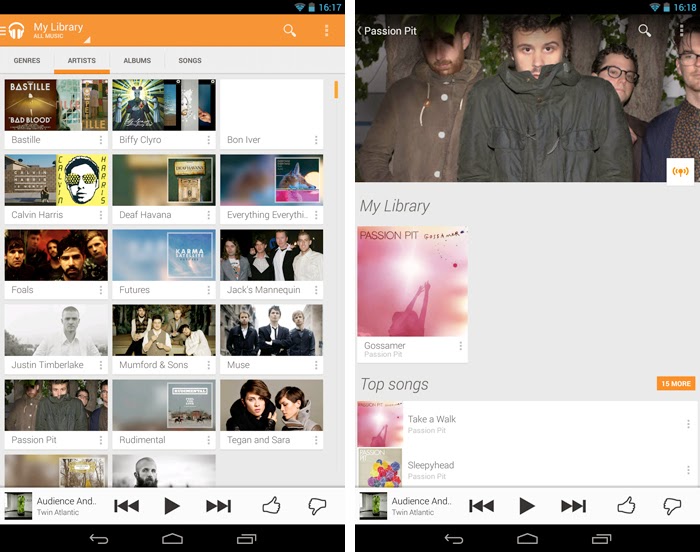
Google Play Music All Access
iTunes Radio

Deezer

With many years under its belt already, Deezer is now a mature service with a catalogue of 30 million tracks available for playback. Like the others, at its most basic it offers playlists, music discovery, favorites and integrated social features but it also offers a wide range of different mobile clients including iOS, Android, Windows Phone 7 and BlackBerry. It’s also available on Mac/PCs too, as well as via a dedicated Windows 8 app.
Users that sign up for a free trial of Deezer Premium+ via Facebook are given 15 days to test out the service, before needing to enter card details to carry on using it. Happily, it’ll work in a lot of different countries too, a full list can be found here.
Xbox Music

It only launched last summer, but it’s already had a makeover for Windows 8.1 and launched on iOS, Android and via a Web player. Naturally, it’s available on Xbox consoles too.
SoundCloud

SoundCloud offers three pricing tiers:
- Free – Offers two upload hours, 100 downloads, unlimited playlists and access to some stats, like number of plays, downloads, comments and favorites of tracks.
- Pro (€3 per month/€29 per year) – Allows four hours of uploads, access to posting tracks in ‘Quiet Mode’ (allowing you to control comments) and Spotlight (allowing you to pin up to five tracks to the top of your profile to receive more attention). It also includes more detailed stats, with reports on who is playing your tracks and where they’re located.
- Pro Unlimited (€9 per month/€99 per year) – Allows you to upload unlimited single sound file sizes up to 2GB each and within an upload time limit of 30 hours per week.
Grooveshark

Slacker Radio

Sony Music Unlimited

The Access Plan is the cheaper of the two — $4.99/£4.99/€4.99 — and allows users to access premium Channels, chart listings and editorial playlists curated by the team. Naturally, it also includes unfettered streaming access to the entire catalogue of tracks, or there’s the option to download playlists to your library for offline access – but only up to a limit of 1,000 tracks.
Mixcloud

Rdio

For $4.99/£4.99 per month, you can get access to unlimited streaming on the Web, shown above. Increasing this to $9.99/£9.99 broadens access to include mobile devices (Windows Phone shown below) and streaming via devices like a Roku media player. There’s also a family plan which includes two (by default, although more can be added) unlimited subscriptions starting from $17.99/£17.99 per month.
TuneIn Radio

Myspace (Music)

Beats Music

Amazon

Round up
As you can see, there are plenty of online streaming options available, with some being more suited to radio listening and others focusing purely on providing individual tracks and albums on-demand.Most of those included in this list offer an algorithm or human curation aspect to discovery of new music, but you’ll likely need to spend some time using any of them before it accurately learns what you like.
Nexus 6 aka Shamu to Feature Snapdragon 805 SoC
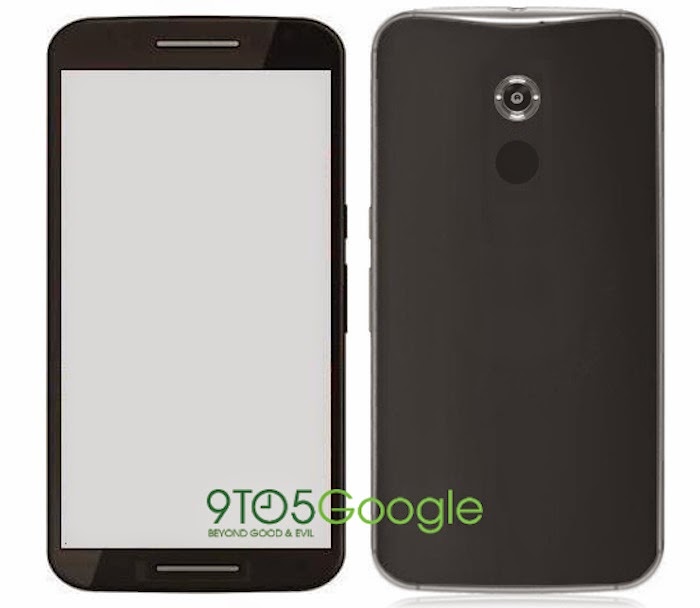
Reports and rumors about the Motorola ‘Shamu’ or the Nexus 6 have been surfacing for quiet some time now. Today, the phone has been leaked in photos which 9to5Google claims are mockups that are based on the real device.
Previous reports had stated that the Motorola Shamu will sport a 5.9 inch screen. Soon after, the phone appeared in GFX and AnTuTu benchmarks with same screen size and a resolution of 2560 x 1440 which is larger than the Moto X. As per the photo, the Motorola Shamu or the Nexus 6 has the same design as the new Moto X.
Moving on, the report also reaffirms the previous specs of the phone like a 2.6GHz quad-core Snapdragon 805 processor, 3GB of RAM, 32GB of internal storage, a 12-megapixel rear-facing camera, a 2-megapixel front-facing shooter and 3200mAh battery. Finally, it looks like the Motorola Shamu will come with Android L. The report goes on saying that the phone will be announced in October and released in November.
Apple Releases iOS 8.0.2 Update with Bugs Fixes

The iOS 8.0.2 update also “includes improvements and bug fixes originally in iOS 8.0.1.
“We apologise for inconveniencing the iPhone 6 and iPhone 6 Plus users who were impacted by the bug in iOS 8.0.1,” Apple said.
On Wednesday, the company was forced to pull the 8.0.1 update after 60 minutes of availability, because of user reports that it was disrupting cellular network connections and Touch ID fingerprint scanning on iPhone 6 and iPhone 6 Plus models.
An Apple spokeswoman said that fewer than 40,000 devices were affected by the bug.
The following is Apple’s list of the fixes included in the 8.0.2 release:
— Fixes an issue in iOS 8.0.1 that impacted cellular network connectivity and Touch ID on iPhone 6 and iPhone 6 Plus
— Fixes a bug so HealthKit apps can now be made available on the App Store
— Addresses an issue where 3rd party keyboards could become deselected when a user enters their passcode
— Fixes an issue that prevented some apps from accessing photos from the Photo Library
— Improves the reliability of the Reachability feature on iPhone 6 and iPhone 6 Plus
— Fixes an issue that could cause unexpected cellular data usage when receiving SMS/MMS messages
— Better support of Ask To Buy for Family Sharing for In-App Purchases
— Fixes an issue where ringtones were sometimes not restored from iCloud backups
— Fixes a bug that prevented uploading photos and videos from Safari
Apple had previously delayed the introduction of third-party HealthKit-compatible apps to the App Store due to a bug in iOS 8. The buggy software release came on the heels of another fiasco for Apple: users reporting that their iPhone 6 Plus models were bending in their pockets.
Several videos appeared on the internet depicting phones being bent by hand. Apple responded to what Twitter users began calling “Bendgate” with an explanation of its iPhone 6 and 6 Plus durability tests, and a statement that only nine users had reported bent iPhone Plus models in the first six days of sales. Apple’s stock fell 3.8 per cent to $US97.87 on Thursday in the US amid the iPhone concerns.
Apple iPhone 6 Plus Bending Issue

When Apple initially unveiled its biggest iPhone to date - the 5.5-inch iPhone 5 Plus - many worried the device would be too big to stuff in their pockets. Now, as it turns out, those who can fit the phone in their pocket are reportedly complaining that the phone bends after being stored there while sitting.
Just days after the phone's launch, some iPhone 6 Plus owners are reporting that their phones look slightly bent and curved from sitting in a pants pocket, according to MacRumors.
The phone looked like this after about 18 hours of sitting the front pockets of a pair of suit pants:
Another commenter called "DevinPitcher" claims the same thing happened to his friend after he put the phone in his front pocket.
MacRumors theorizes this "bending" effect could be the result of the phone's size. Since it's so large and thin, it's susceptible to bending with your body as you move. Smaller phones would slide out of the way, MacRumors claims.
It's unclear exactly how authentic these claims are, and this isn't the first time we've seen these types of complaints. Last year, Cult Of Mac reported that some users also complained that the iPhone 5s would bend after being stored in your pocket.
ISRO Makes History as Mangalyaan Enters Mars Orbit

September 24 will go down in history as a red letter day. India successfully placed its spacecraft in orbit around Mars, becoming the first country in the world to succeed in such an inter-planetary mission in the maiden attempt itself.
At 7.17 am, the 440 Newton Liquid Apogee Motor sizzled with life as it burnt along with the thrusters to slow down the Mars Orbiter Mission spacecraft to be capturedby the Red Planet.
"MOM has met Mangal," Prime Minister Narendra Modi said announcing the mission's success, after nerve-wracking final moments at the command centre of Indian Space Research Organisation in Bangalore.
Modi, who witnessed the operation along with the space scientists, said the odds were stacked against "us with only 21 of the 51 missions to Mars being successful," but "we have prevailed."
An elated Prime Minister patted the back of Indian Space Research Organisation Chairman K Radhakrishnan and complimented the Indian space scientists for making space history.
With the success of Mangalyaan, India has become the first country in the world to go to Mars in the very first try. European, American and Russian probes have managed to orbit or land on the planet, but after several attempts.
Mars Orbiter Insertion was carried out automatically by commands loaded onto the spacecraft after its velocity was slowed down from 22.1 km per second to 4.4 km per second to be captured by the Martian orbit. The spacecraft had entered the Martian neighbourhood on Monday. At the time of MOM's orbital insertion, its signals took about 12 minutes and 28 seconds to travel to Earth for reception by NASA's Deep Space Network Stations in Canberra and Goldstone that relayed the data in real time to ISRO's station in Bangalore. The first sign of success in the final moments came when ISRO announced that burn of engines on India's Mars orbiter had been confirmed. "All engines of Mars orbiter are going strong. Burn confirmed," said ISRO signaling that history was in the making.
Igniting the main engine was critical as it had been lying in slumber for about 300 days and was woken up briefly for four seconds on Monday.
It was a make or break tricky manoeuvre as even the slightest error would have pushed the orbiter into deep depths of space. Much of the spacecraft's manoeuvre took place behind Mars, as seen from Earth. This meant that from a point four minutes into the Mars Orbiter Insertion burn until three minutes after the scheduled end of the manoeuvre, teams on Earth had no insight into the spacecraft's progress.
The Rs 450-crore Mangalyaan aims to study Mars' surface and mineral composition, and scan its atmosphere for methane, a chemical strongly tied to life on Earth. The spacecraft was launched on November 5, 2013 on homegrown PSLV rocket from Sriharikota in Andhra Pradesh on its nine-month long odyssey. It had escaped the earth gravity pull on December 1, 2013. The 1,350 kg spacecraft is equipped with five instruments including a sensor to track methane or marsh gas -- a possible sign of life, a colour camera and a thermal imaging spectrometer to map the surface and mineral wealth of the Red Planet.
ISRO's
Mars Orbiter Mission (MOM) on Wednesday successfully entered the orbit
of the red planet. With this, India has become the first nation in the
world to have entered the Mars orbit in the first attempt. ISRO's MOM
is also the cheapest such mission till now.
European, US and Russian probes have managed to orbit or land on the planet, but after several attempts.
European, US and Russian probes have managed to orbit or land on the planet, but after several attempts.
ISRO's
Mars Orbiter Mission (MOM) on Wednesday successfully entered the orbit
of the red planet. With this, India has become the first nation in the
world to have entered the Mars orbit in the first attempt. ISRO's MOM
is also the cheapest such mission till now.
European, US and Russian probes have managed to orbit or land on the planet, but after several attempts.
European, US and Russian probes have managed to orbit or land on the planet, but after several attempts.
GetActive Tapp Fitness Band Launched at Rs 4999

Bangalore based health management services company GetActive has launched the new personal health and activity tracker called GetActive tapp. The wearable device is similar to other fitness trackers and will track daily activity like steps taken, calories burnt, time spent in the day and distance covered in kilometres. It can connect to smartphone with Bluetooth LE and then transfer the data from the device to the smartphone. The app for smartphones is now available for iOS and Android.
Another feature of GetActive Tapp is that you can accumulate points for each step you take with the device which can be later redeemed at the partner sites. As of now there is no information on the partner sites. The wearable device follows WHO guidelines to benchmark activity levels as per the company. The device comes with a 110mAh battery and would last for a good 4-5 days according to the company. The device is priced at Rs 4999 and will be available next month. You can buy it from Myntra or the company’s official website.
2mpower Health Management Services, the company behind this fitness tracker has got funding from Chairman of Manipal Global Education Services TV Mohandas Pai and former Infosys CTO Sharad Hegde. The device will have competition from other Indian players like GoQii which launched their fitness tracker recently in India.
Jolla Sailfish OS Smartphone Launched for Rs 16,499

In July, Finnish smartphone company Jolla announced that it planned to enter the Indian markets with Sailfish OS-powered devices. The company even sent out a tweet from its official account confirming the India launch alongside an exclusive tie-up with Snapdeal. Two months later, the device has finally reached Indian shores and will be available for purchase exclusively via Snapdeal for Rs 16,499. The phone is available in Poppy Red, Keira Black and Aloe colours.
The Jolla smartphone features a distinct button-less design, and the Sailfish OS gesture-based user experience. Sailfish OS is based on Meego, a Linux-based mobile operating system that Nokia had been working on. It was later put on hold as it wanted to focus on Windows phones.
Former Nokia employees revisited the project to bring the Jolla smartphone which runs on Sailfish OS. The Sailfish UI’s biggest strengths includes focus on multi-tasking without jumping in and out of apps. As is becoming the norm nowadays, there is also a big emphasis on gestures for navigation and selection of content.
Jolla integrates Android apps so users can enjoy a majority of apps that are popular on Android. Other features include Live multitasking, which lets users use multiple apps simultaneously and a unique interface that supports new gestures such as peek and pull. The Home view shows you commonly-used apps, while app shortcuts can be accessed with a swipe. For example for switching music tracks and opening a new browser window.
The phone sports a 4.5-inch 960 x 450 display, 8 MP main camera and a 2MP front camera and packs 16GB of built-in storage. The phone is powered by a dual-core Qualcomm Snapdragon processor, which is clocked at 1.4 GHz and backed by 1GB RAM. There’s a user-replaceable 2100 mAh battery, which Jolla claims, provides up to 10 hours of call time.
Interestingly, today is the day when Xiaomi will be selling 60,000 Redmi 1 s units on Flipkart, so looks like both Snapdeal and Flipkart will be enjoying the limelight today. However, unlike, the hordes of budget-phone makers entering the Indian market, the Jolla smartphones comes at a slightly higher price tag of Rs 16,499.
India Embellish the 2nd Largest Smartphone Market by 2019

India is poised to surpass the United States to become the second largest smartphone market by 2019, according to a latest report by Boston-based global market research firm Strategy Analytics.
Beating the slowdown trends, global smartphone sales will grow 13 percent in 2015, it added. ”China and the US will remain the largest smartphone sales countries by 2014, making up 43 percent of global volumes,” the report said. The world’s top 20 countries will account for 80 percent of the global smartphone volumes in 2015, up from 75 percent in 2007.
Asia Pacific will continue to drive growth, accounting for 54 percent of the global volumes in 2015. Central Latin America and Africa Middle East will see strong smartphone growth by 2020 and will play the role of a new growth engine for global market, it said.
Google Launches Initiatives with Indian Govt For Digital Literacy in India

Search giant Google today said it is working with government to launch a nationwide contest for developing a mobile application for the PM's Office, an initiative to support the Digital India programme.
"MyGov, the citizen engagement platform of the Government and Google are collaborating to launch a nationwide contest to develop a mobile app for the PM's Office," Google said in a statement.

The search giant said it will continue to build a vibrant language ecosystem online and help the government transition into the increasingly 'mobile' India. To encourage digital literacy and Internet safety, Google is also introducing curriculum for schools, officials and elected representatives. Google is working with the Department of Information Technology and other state governments to develop these initiatives. Google India Vice President and Managing Director Rajan Anandan said India is already home to the third largest number of Internet users globally with 245 million users as of June 2014 and is on track to become the second largest user market by 2015 and a 500 million-user market by 2016.
"Yet, there are more than a billion people who will need to be brought online for India to realise the vision of a digitally connected, knowledge economy. Prime Minister Modi's Digital India programme will play a transformational role in achieving this," Anandan added.
iGaze Connects Devices with a Glance

A new headset has been created which lets you connect to devices just with a glance. Researchers have built a new wearable headset which tracks the users gaze and connects him or her to the devices he or she looks at.
The new gadget is called iGaze and contains an eye-tracking camera which calculates where the wearer is looking and transmits it to all the nearly internet-connected devices, such as stereos and TVs via Wi-Fi. The devices within the field of view reply with a beep played through the headset. When the wearer hears it, they need nod to confirm a desire to connect. The two speakers in the headset then send out an inaudible sound which Mics in the nearby devices use to calculate where the wearer is standing, enabling each device to discern if it has been selected.
Two people wearing the iGaze headsets can also connect with each other. The iGaze will allow wearers to swap files or contact information with a glance or tap on the headset. The device has been developed by Lan Zhang at Tsinghua University in China who said it could let wearers interact with the world in various ways. For example, in museums, the device’s head-up display could serve up extra information when a visitor looks at a given exhibit.
Tag :
entertainment,
technology
NSA Monitoring ISIS' Cyber Capabilities

As U.S. military leaders outlined their strategy before Congress to fight Islamic State militants on the battlefield, the National Security Agency chief said on Tuesday he was watching the media-savvy group's cyber capabilities.Asked whether the Sunni Muslim group was planning cyber attacks on U.S. interests, Admiral Mike Rogers said he could not discuss specifics of the organization's technical capabilities.
"We need to assume that there will be a cyber dimension increasingly in almost any scenario that we're dealing with," Rogers said at a cybersecurity conference in Washington. Islamic State, which controls large swaths of Iraq and Syria, has posted carefully choreographed beheading videos online, trumpeted its violent acts on Twitter and used social media to recruit foreign Islamists to the fight.
"Its public messaging and social media is as slick and as effective as any I've ever seen from a terrorist organization," Homeland Security Secretary Jeh Johnson told the Council on Foreign Relations in New York last week.
Cybersecurity expert James Lewis of the Center for Strategic and International Studies said he did not think Islamic State posed any immediate cyber threat to American interests. While there may be no imminent or specific cyber threat from Islamic State, there is a wide-ranging intent to damage the West, a congressional aide said. Different jihadist groups have talked about launching cyber attacks and it may be just a matter of time before they find someone capable of doing it, the aide said on condition of anonymity.
Rogers, speaking generally on how cybersecurity threats are proliferating across all aspects of American life, said: "There is nothing but increased activity out there." As Pentagon officials told Congress on Tuesday they were preparing for a longer-term campaign against Islamic State in Syria and Iraq, Rogers said cyber defense was a long-haul effort.
The U.S. Cyber Command he leads hopes to have 6,200 cyber employees by 2016 to detect and deflect such threats, and Rogers urged greater cooperation on cybersecurity between government, business and industry. "There are a lot of groups out there - individuals, nation-states - who feel that this is an area worth investing in, because it achieves positive outcomes for them if they can penetrate systems," Rogers said at the Billington Cybersecurity Summit.
Sony's SmartEyeglass to Launch Next Year


At very first it was Google who came up with Google Smart Glass then after a long gap Lenovo also announced of its upcoming Lenovo Smart Glass followed by China’s search giant Baidu who announced Baidu Eye a chinese smartglass to rival Google and now this time it was technology giant Sony who also announced its Smart Eyeglass in Tokyo, Japan on Friday, 19th September, 2014. The SmartEyeglass from Sony is a transparent lens eyewear that works by connecting with compatible Smartphones to superimpose information such as images, texts, and symbols, onto the user’s field of view. Only Smartphones having Android 4.1 or later will be compatible with the SmartEyeglass. Further, Android 4.3 or later is necessary in order to make use of the video functionality of the camera.
The SmartEyeglass will offer the users a diverse range of sensing technologies, which includes an accelerometer, brightness sensor, Gyroscope, a CMOS image sensor, microphone and an electronic compass. The SmartEyeglass makes use of the above mentioned features along with the GPS location information provided by the connected Smartphone, in order to give information most optimized to the user’s current circumstances.
Technical overview of the SmartEyeglass prototype
- Binocular see-trough eyewear display.
- Monochrome green colour.
- Maximum display brightness: 1000cd/m2.
- Embedded camera.
- Accelerometer, gyro, compass and brightness sensors.
- Microphone.
- Bluetooth v3.0.
- WiFi – 802.11b/g/n.
- Separate controller with touchpad along with power, navigation and camera buttons.
At the announcement, Sony also demonstrated some preloaded apps on the SmartEyeglass. A Localive app provides social feeds aggregation and distribution for surrounding local area whereas its-mo NAVI for SmartEyeglass app provides pedestrian navigation. Sony has also announced the availability of a dedicated SmartEyeglass Software Development Kit (Developer Preview) which would enable developers to think upon new and innovative ideas for creating scenarios where the device can be used. The kit will also boost the development of various applications. The kit comes with an emulator, sample code, tutorials to get started, In-depth developer guides, Design guidelines, API references, test instructions and Publishing guidelines.
iOS 8 Has Finally Arrived


Apple on Wednesday released the latest version of its mobile operating system for iPhone and iPad users. Some new features include support for third-party keyboards (such as Swype), Touch ID for third-party apps, and new widgets for quick app alerts in the notification center.
iOS 8 is compatible with any iPhone that's 4S or later, the fifth-generation iPod Touch, or any iPad released from the second generation on. Some features are specific to the iPhone 6 and 6 Plus, including Apple Pay. The mobile payments service, which works with the NFC chip in the new iPhones, will launch through an iOS 8 update for the 6 and 6 Plus in October. You can download the software by going to the settings app (Settings > General > Software Update) or by plugging your device into iTunes. Apple on Friday also will be shipping iOS 8 on its new iPhones, the 6 and 6 Plus.
iOS 8 marks the second major release of Apple's mobile operating system under the guidance of head designer Jony Ive and new software head Craig Federighi. Apple CEO Tim Cook fired the prior iOS chief, Scott Forstall, in October 2012 in part for refusing to take responsibility for Apple's Maps fiasco. Ive spearheaded a complete redesign of iOS 7, the first major overhaul since Apple introduced the software with the first iPhone in 2007.
Features Include
- Safari Credit Card Scanning
- Battery Usage by App
- Wi-Fi Phone Calls
- Time-Lapse Camera Mode
- Hide Images in Photos App
But there are features that make the iOS 8 update totally worth it. We take a look at five quick points.
- HealthKit and Health

Share and collate health and fitness information through the Health app, complete with the option to create your own medical emergency card

View your most recent health and fitness data in one dashboard, while tracking each app individually through HealthKit
- HomeKit

- Messaging

Voice messaging is now available to send within texts and iMessages
- Touch ID

Touch ID was first introduced in last September's iPhone 5s
- QuickType

iOS 8 provides users with a whole new world of typing opportunities, from swiping rather than typing, or using a traditional keyboard layout.
- Photos and Camera

The iCloud Photo Library allows you to access your pictures from any iOS device.
- iCloud Drive

Access all presentations, documents and images in the iCloud to access through any iOS-enabled device
- Family Sharing

Music, films, books and apps can be shared between family members at the tap of a screen
- Spotlight

Spotlight now considers features such as location and context in its searches
- App Store updates

The App Store has been given an iOS 8 revamp
- Send last location to Apple before your battery dies

- Identify songs

- Credit card scanning

- Hide images from Photos app

- Phone calls over Wi-Fi

- Find which app is using the most battery life

- Get Tips on Using iOS 8 (beta 4)

- New smart Photo Albums

- Time-lapse photography

- Recover deleted photos

- Request desktop site in Safari

- Quick access to recent photos

- The Weather Channel

- Calendar
- FaceTime


- Podcasts

- Choose when an app can use location data

- Grayscale mode

- Improved zoom


- Share sheet customizations
- iTunes Radio in Control Center


- Control Center Redesign

- iCloud Drive

- Suggested Apps

- SMS Relay

- Emoji keyboard icon

- iCloud icons

- Predictive text

- Safari password sharing

Many of the tech giant's recent mobile products will be able to
receive the update. According to Apple, the full list of compatible iOS 8
devices include:
- The iPhone 4S
- The iPhone 5
- The iPhone 5C
- The iPhone 5S
- The iPhone 6 (available Friday)
- The iPhone 6 Plus (available Friday)
- The iPod Touch fifth generation
- The iPad 2
- The iPad with Retina Display
- The iPad Air
- The iPad Mini
- The iPad Mini with Retina Display
Devices that will miss out on the iOS 8 update will be:
- The iPhone 4 and older iPhones
- The iPod Touch fourth generation and older models
- The original iPad
Tag :
apple,
apps,
ceo,
communication,
internet,
ios,
ipad,
iphone,
news,
official,
services,
steve jobs,
technology,
updates,
user


