


Archos Unveils 97 Carbon Android Tablet for $250

Announced Thursday, the tablet is the first in a line of slates from the company’s entry-level Elements line. It runs Android 4.0, also known as Ice Cream Sandwich.
The 9.7-inch Carbon — the same size as the iPad — has a
>> 1024 x 768 display
>> 1GHz ARM processor
>> 1GB of RAM
>> Fforward and a Rear-Facing Camera
>> 16GB of built-in memory (expandable via microSD up to 32GB)
>> "Stylish Premium Aluminum” Finish.
The 97 Carbon will be available later this month for $249.99. The company also plans to bring a 7-inch and 8-inch tablet into the Elements line in the future, which would presumably be priced even lower. We were impressed with the Nexus 7, which is $50 cheaper than the 97 Carbon, comes running the latest version of Android (Jelly Bean), and comes with a $25 credit for the Google Play Store, which undercuts the price even further.
How Android Phone Owners Use Their Devices

If you have a Samsung Galaxy-S and live in Sweden, chances are you like to talk on your mobile device using Bluetooth while on-the-go — that’s according to a recent study that shows Swedes use Bluetooth and wireless headsets more than people from any other country (47%). And owners of Samsung Galaxy-S phones use the most minutes per month of all Android devices (431).
An Android app that measures how much radiation your phone is emitting, and by the company inneractive, which is a mobile app monetization exchange, created this infographic based on Tawkon’s data for Android devices. This data was gathered from Tawkon’s millions of daily data points over a period of several months.
Tag :
android,
mobile phones
Seven-Inch Kindle Fire 2 Might Ship In Early August

While that still might be when it’s announced, a more recent rumor suggests that the KF2 will get here a little farther out, shipping on August 7.
This date comes from Amazon’s manufacturing partners in Southeast Asia, and supposedly only concerns the seven-inch Kindle Fire 2. While it looks like larger 8.9 and 10-inch models are still possibilities, they wouldn’t become available until some later date.
With the Nexus 7 shipping this month, and the iPad Mini seeming more and more likely for early this fall, we could be looking at a close race to dominate the seven-inch tablet market as sales ramp-up towards the holiday season. That means that Amazon is going to have to be competitive when pricing the Kindle Fire 2, making a return to the first model’s $200 launch price seem likely. Even then, Amazon’s going to have quite the fight cut out it for it, going up against these heavyweights.
Tag :
kindle fire
Corrupt Apps Flood iOS App Store

A number of iOS apps that posted updates in the App Store in the last couple of days are crashing upon launch. The issue appears to be affecting many apps, including popular ones such as Instapaper and Angry Birds Space.
The first official word about the problem appears to be from Instapaper creator Marco Arment. In a blog post he explains that after the latest Instapaper update went live on the evening of July 3, many users were complaining the app was crashing immediately upon launch, regardless of whether the user had merely updated the app, or started from scratch.
Arment soon found the problem wasn’t just with his app. Other developers and their users have been experiencing the same problem, including GoodReader for iPad and the free version of the popular game Angry Birds Space. Arment includes a list of the known corrupted apps in his post, all of which posted updates July 3-4.
Twitter to Announce a Big Search and Discovery Change Today

Twitter has a big search and discovery announcement today, according to a tweet by the company’s Personalization and Recommender Systems Chief Pankaj Gupta.
“Search & discovery in @twitter set to change forever after tmrw,” tweeted Gupta Thursday, without giving away any other details.
It’s a long shot, but today’s possible announcement could be somehow tied to Twitter’s recent criticism of Google, after the company tightly integrated Google+ into its search results.
Facebook’s New App Store Arrives

Facebook has begun rolling out its apps marketplace internationally, launching a version for UK users Friday morning.
Facebook’s App Center (or Centre, in British spelling) launched in the U.S. early last month. It’s similar to Apple’s, Google’s and Amazon’s app stores, allowing users to browse apps by category, such as Games or Sports, and filter to show apps that are available via the web, mobile or both. Apps are recommended based on collective ratings, personal recommendations, what’s trending and popularity among your friends.
The App Center isn’t exclusively made for Facebook’s apps: It also indexes apps available only on third-party sites, or through other mobile app stores. When users click to sign up for apps like Netflix and Hulu, for instance, they are sent to their respective websites; other times, they’re sent to Apple’s App Store or Google Play. In the somewhat rare instance where a paid app is sold directly through Facebook’s store, the company takes a 30% cut; it takes the same cut of purchases made within apps based on its platform.
If Hackers Didn't Exist, Governments Would Have to Invent Them

According to the Privacy Rights Clearinghouse, the loss or improper disposal of paper records, portable devices like laptops or memory sticks and desktop computers have accounted for more than 1,400 data-breach incidents since 2005 — almost half of all the incidents reported.
More than 180,000,000 individual records were compromised in these breaches, which included individuals’ names, Social Security numbers, addresses, credit-card information and more. This is compared to the 631 incidents from the same period that the Clearinghouse assigns generically to “hacking or malware.” Your private data is more likely to be put at risk by a factotum leaving a laptop on a train than by a wired teen with too much time on his hands.
the recent high-profile security breach at LinkedIn shows that one of the greatest risks to our personal security is ourselves: more than two-thirds of the leaked LinkedIn passwords were eight characters or fewer in length, and only 1% used the mix of upper- and lower-case characters, numbers and symbols that makes passwords difficult to crack. But these more serious threats don’t seem to loom as large as hackers in the minds of those who make the laws and regulations that shape the Internet. It is the hacker — a sort of modern folk devil who personifies our anxieties about technology — who gets all the attention.
The result is a set of increasingly paranoid and restrictive laws and regulations affecting our abilities to communicate freely and privately online, to use and control our own technology, and which puts users at risk for overzealous prosecutions and invasive electronic search and seizure practices. The Computer Fraud and Abuse Act, the cornerstone of domestic computer-crime legislation, is overly broad and poorly defined.
The hacker in American film, almost always white, middle class and male, is immature, socially alienated, vindictive and motivated by selfish goals or personality problems. The plots of such films are built on apocalyptic techno-paranoia, reflecting a belief that hackers have supreme control over the technologies that make the world run. News coverage parallels the pop culture frame. Basement-dwelling hackers remain a primary villain on the evening news and the front page, even at the cost of an accurate and rational portrayal of current events. “Hacking” is used as a catch-all term to describe almost any computer-related crime or “bad” action, no matter the skills or techniques involved.
Recent court decisions, like the opinion handed down by the Ninth Circuit in US v. Nosal, work to narrow the scope of the CFAA, which gives hope to the idea that it is possible to regulate the Internet in a more reality-driven way. In order to achieve that regulation, though, we must discard the hacker stereotype as a central social villain and legal driver. The past few years have seen the internet emerge as a central haven for political speech, domestically and internationally. The Internet has been used to exchange ideas, organize protests and overthrow dictators.
Tag :
government,
hackers
Mozilla Foundation Announces Firefox OS for Mobile, Smartphones Coming in 2013


Mozilla, the company behind the Firefox web browser, is planning a completely open mobile operating system, and today it revealed its official name: Firefox OS.
The first Firefox OS devices are expected in 2013, and Mozilla has already lined up some extensive support for the project. China’s ZTE and TCL, two large phone manufacturers, said they would build devices using Qualcomm Snapdragon processors, the same kind of chip in the Samsung Galaxy S III.
In addition, wireless carriers throughout the world have voiced support for Firefox OS, including Deutsche Telekom (the parent of T-Mobile), Etisalat (which operates in 18 countries throught the Middle East, Asia and Africa), Sprint in the U.S. and Spain’s Telefónica, which will release the first Firefox devices in Brazil.
Mozilla says Firefox OS will be a “fully open mobile ecosystem,” built entirely on open web standards, with apps developed as HTML5 applications. HTML5 is a standard for supporting advanced functionality in web pages — when an app launches in your smartphone’s browser instead of as a native app, chances are it was made with HTML5.
5 Chinese Social Networks You Need to Watch

Connections mean “power” in China. This is why social networks have become part of the relationship-building fabric of Chinese society. The numbers certainly bear this out. Roughly half of China’s 513 million netizens are using social networking sites, and all of these social networks are home grown.
1. Sina Weibo
Simply describing Sina Weibo as the Twitter of China understates Weibo’s unique capabilities and leadership role in the Chinese social media sphere. With more than twice as many users as Twitter, Sina Weibo is an essential platform to more than 22% of the Chinese Internet population. Part of its popularity can be attributed to the ability of users to include images and video, something Twitter is only now beginning to allow.
Today it’s the top platform for social discourse and a big driver for consumer activity. It’s also a celebrity hub. Just as American celebrities communicate with their fans via Twitter, Chinese celebrities depend on Weibo as a way to connect with their fans and drive popularity. Interestingly enough, Bill Gates easily has twice as many followers as Tom Cruise on Twitter (Gates with 7,215,994 and Cruise with 3,077,444), but Cruise has 4,231,919 followers on Weibo, one million more than Gates.
2. Renren
Think of Renren as China’s Facebook. After a fierce competition with Kaixin (www.kaixin001.com), Renren has come out on top. Originally, Renren lost a lawsuit about its domain name — www.kaixin.com — because it was so closer to Kaixin’s. Still, Renren managed to retain ownership of that url, which now re-directs to its site. This move comes as Renren tries to expand beyond its predominantly student user base. With 147 million registered users and 31 million active users per month, Renren is poised to take over as the social networking platform for the college-educated population in China.
3. Tencent
Tencent is thought of as a platform for the masses and was essentially built on the QQ Instant Messaging service. With a QQ account, a user can get access to all of Tencent’s different services. In other words, it’s the equivalent of a social media hub. Yes, Tencent’s social networking site Pengyou has lower numbers of active users than Weibo, and Renren. However, because of its multiple platforms, it maintains the biggest community in China in terms of sheer registered users.
4. Douban
Douban is the open forum popular among intellectuals for movie, music and book reviews, with around 60 million registered users and 80 million active users per month. These figures reflect that fact that Douban allows unregistered users to access about 80% of the site’s content.
Two other platforms are in this same space and hoping to catch up. One is Diandian, which could easily become the next “Tumblr of China.” The number of registered blog users on Diandian has hit five million since its founding in 2010. Another specialized social network making noise is P1.cn, an invite-only platform focused on the top 10% of Chinese earners. It has more than 2.7 million members.
5. Wechat
There’s no question that the mobile space will be the next battleground in China for social networks. That’s because more than 69% of the Chinese population accesses the internet through mobile devices. Wechat — formerly known as Weixin — is a mobile voice and text app with social features like “friend discovery.” Although not initially a typical social network, Wechat has continually added more social networking features to its product, including a photo-sharing platform and an LBS component. Currently, it has more than 100 million users.
As social platforms adopt mobile apps to supplement their online platforms, some have decided to make mobile their focus. Several location-based services such as Jiepang (a FourSquare-like app) and Momo (a dating app) have gained popularity in the past year in their respective markets.
Tag :
social network
Relationship Between College Students and Their Smartphones

Thirty-five percent say they sometimes use their phones while driving but stopped at a red light, and nearly 20% say they sometimes use them while the wheels are even moving. But it’s not all addiction and danger. Forty-five percent of college students say smartphones frequently help with school assignments, and 46% say they’re often helpful for work-related tasks. The Internet education portal OnlineColleges pulled this data and more from sources including the Pew Internet & American Life Project, University of Colorado and Nielsen to produce the infographic below.
Tag :
education,
smartphones
Google Nexus 7 Tablet Launched

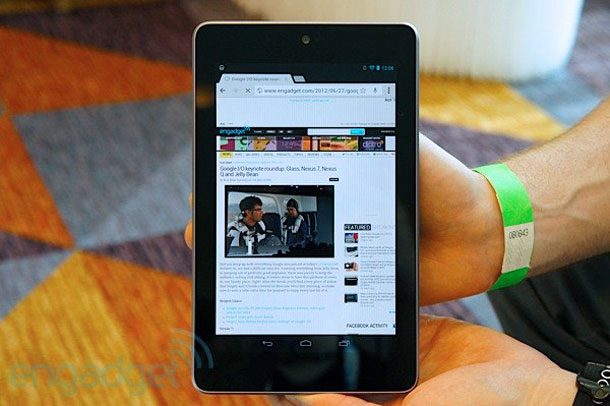
On Wednesday Google unveiled tablet computer - the Nexus 7 that will start shipping next month. The tablet also could appeal to consumers looking for a less expensive, less sophisticated alternative to Apple Inc.'s iPad & also giving a direct competition to Amazon.com Inc.'s Kindle Fire.
The Nexus 7 is designed specifically for Google Play, an online store that sells movies, music, books, apps and other content. That mirrors Amazon's strategy with the Kindle Fire, although Amazon's strength in online retailing has seeded its store with a more extensive selection than Google Play. Amazon declined comment.
Google announces Android 4.1, Jelly Bean
The size and price of the Nexus 7 also matches the Kindle Fire. Both have 7-inch screens and sell for $199. The Nexus 7 is slightly lighter at about 0.75 pound, compared with the Kindle Fire's 0.9 pound.
By contrast, the iPad's screen measures nearly 10 inches diagonally and weighs 1.44 pounds. Apple sells its latest models for $499 and up, though an older version is available for $399.
Customers can start ordering the Nexus 7 through Google on Wednesday, initially in the US, Canada and Australia. The device won't ship until mid-July. Google's announcement that it's putting its brand on a tablet comes a week after Microsoft Corp. did the same thing. Both moves risk alienating Google's and Microsoft's hardware partners. Those companies, in turn, could be less inclined to work closely with Google and Microsoft.
The Nexus 7's price looks like a relative bargain, given that it boasts more features than the Kindle, including a front-facing camera with 1.2 megapixels. The Kindle is believed to be a roughly break-even product for Amazon at $199. Samsung Electronics Co. sells a tablet similar to Google's for $250.
Google has previously put its own brand on a flagship line of "Nexus" smartphones. But that market is more mature than the tablet market, and there was less risk of Google alienating partners, particularly because it didn't price the phones lower than the norm. Much like the Nexus phones, the Nexus 7 tablet will be a showcase for a new version of Google's Android operating system - this one called Jelly Bean.
For Google, advertising dollars are at stake. If Apple retains its dominance and other players such as Amazon and Microsoft gobble up the rest of the sales, they could set up their operating systems in ways that de-emphasise Google's Internet search engine and other services. Apple develops its own system, while Amazon modifies Android for use in Kindles. Microsoft's will run on a new version of Windows.
What Happens To Your Online Data After Death?

Most of us live two lives - the physical one and a virtual mirror of it online. When we die, our physical existence comes to an end even as our virtual presence lingers on. So, what happens to all this content we have created, our online accounts and virtual transactions? What happens to all that we have stored in the cloud and, unknowingly, in servers across the globe?
BLOGS, PHOTOS, FINANCIAL ACCOUNTS
Like all creative products, literary works, research notes, photographs, etc, that are created online will pass on to the legal heir of the deceased.
There is, however, no specific law in India on this, but they are considered intellectual property and treated likewise. Similarly, legal heirs have the right to access bank accounts and online records with, say, the Income Tax Department. Companies will have first right to stuff lying in official email services and servers.
YAHOO
Email accounts of Yahoo are automatically deleted if it stays dormat for over four months. Yahoo will also close the account if a copy of the death certificate is emailed to cc-advoc@yahoo-inc.com.
Google says that in rare cases it "may be able to provide the Gmail account content to an authorised representative of the deceased user".
But the post on Google Support adds that "any decision to provide the contents of a deceased user's email will be made only after a careful review, and the application to obtain email content is a lengthy process.
Before you begin, please understand that Google may be unable to provide the Gmail account content, and sending a request or filing the required documentation does not guarantee that we will be able to assist you." The same applies to all Google services.
Facebook gives friends and relatives the option of memorialising a deceased person's account to protect privacy. "Memorialising an account sets the account privacy so that only confirmed friends can see the profile or locate it in search. Friends and family can leave posts in remembrance," says the Facebook blog.
It also prevents anyone from logging into the account. Facebook does not divulge login details of the account, but "verified immediate family members" can also request the removal of an account.
... AND WHAT OTHERS DO
Microsoft-MSN: Account data on email or any other MSN service is transferred to legal heir after death if verified and preserved till that time.
LinkedIn Twitter: Account shut if 'death verification form' or request submitted.
Flickr: Account is terminated and photographs and content permanently deleted if copy of death certificate is provided.
Orkut: Profile removed if death certificate is uploaded and an online form completed.
PayPal: If death is reported, account will be closed and a cheque made out to the account holder is issued to the legal heir.
eBay: All data of the user on the buy-sell website is deleted if death certificate is faxed to company.
Adobe Won’t Support Flash in Android 4.1

Adobe has announced it will not support Flash Player browser plugin for Android 4.1 and onward.
“There will be no certified implementations of Flash Player for Android 4.1,” writes Adobe on its official blog, adding that it recommends “uninstalling Flash Player on devices which have been upgraded to Android 4.1.”
It all started with Steve Jobs, though, who famously called Flash a “relic” from another era in an open letter in April 2010. Apple then said it would not support Flash on the iPad, iPhone and iPod touch, and for a while Flash support was seen as a competitive advantage for Android.
Now, it’s really the end of the line for Flash on mobile devices, as Adobe will disable fresh installs of Flash from the Google Play store after August 15.
Google vs. Bing: Battle of the Search Engines

One engine is trying to get to know what the web is looking for, providing quick and handy summary information for some searches so you can find what you need quickly. Meanwhile, the other is turning searches social, suggesting information from your friends on social networks and even enabling you to seek a friend’s advice while searching to make sure you get the best answer possible.
Google : Quick Answers
Google started rolling out its knowledge graph across all search tools in May. Now, when you search for something in Google, the engine will try to determine exactly what you are searching for by tapping into information from knowledge databases, such as Freebase, Wikipedia and Google Maps. Since the engine is looking at topics as a whole rather than simple keywords, searches are more intuitive and more likely to provide information about what you’re really looking for.
A summary of some topics also appears on the right side of the page beside your search results. For instance, a search for “William Shakespeare” will bring up a photo of the playwright from Wikipedia along with a brief biography and a short list of his plays. Google+ results also show up in summary information and search results. In the case of our Giants search, for instance, the most recent update on the team’s Google+ page shows up.
Bing : Social Answers
Bing takes social media searches to a whole new level. Where Google has a summary on the right-hand side of the page, Bing instead provides information from social networks. While the platform only provides information from Facebook, Bing has plans to integrate Twitter, Google+, Quora and LinkedIn into search as well. The toolbar, labeled “What Your Friends May Know,” showcases information about your search topics from friends on various social media sites, and also offers the option to pose questions to those friends to help with your search.
In addition to finding out what your friends know, Bing searches also offer a “What Bing Knows” tab, providing varying levels of information on things like local restaurants, movies, events and people. A “What the Web Knows” tab provides general results from the web. At the time of launch, Bing executive Derrick Connell told Mashable that the goal of the new Bing is to “surface people, not web pages.”
Which Is Best ?
What search engine is best depends on how you plan to use it. While Google’s search may be best for gathering information about your favorite sports team or a famous author, Bing may have the search giant beat in the realm of social and local knowledge.
Tag :
google,
search engine
Sheryl Sandberg Is Facebook’s First Female Board Member

Facebook announced on Monday that its chief operating officer Sheryl Sandberg has joined the company’s board of directors, making her the company’s first-ever female board member.
Sandberg — who oversees Facebook’s business operations including sales, marketing, business development, legal, human resources, public policy and communications — will joining existing members such as Facebook co-founder and CEO Mark Zuckerberg, Netflix chairman and CEO Reed Hastings and chairman and CEO of The Washington Post Company, Donald E. Graham.
It’s been previously reported that Sandberg got paid $30.87 million last year, making her the most highly compensated employee at the company in 2011.
Tag :
facebook


